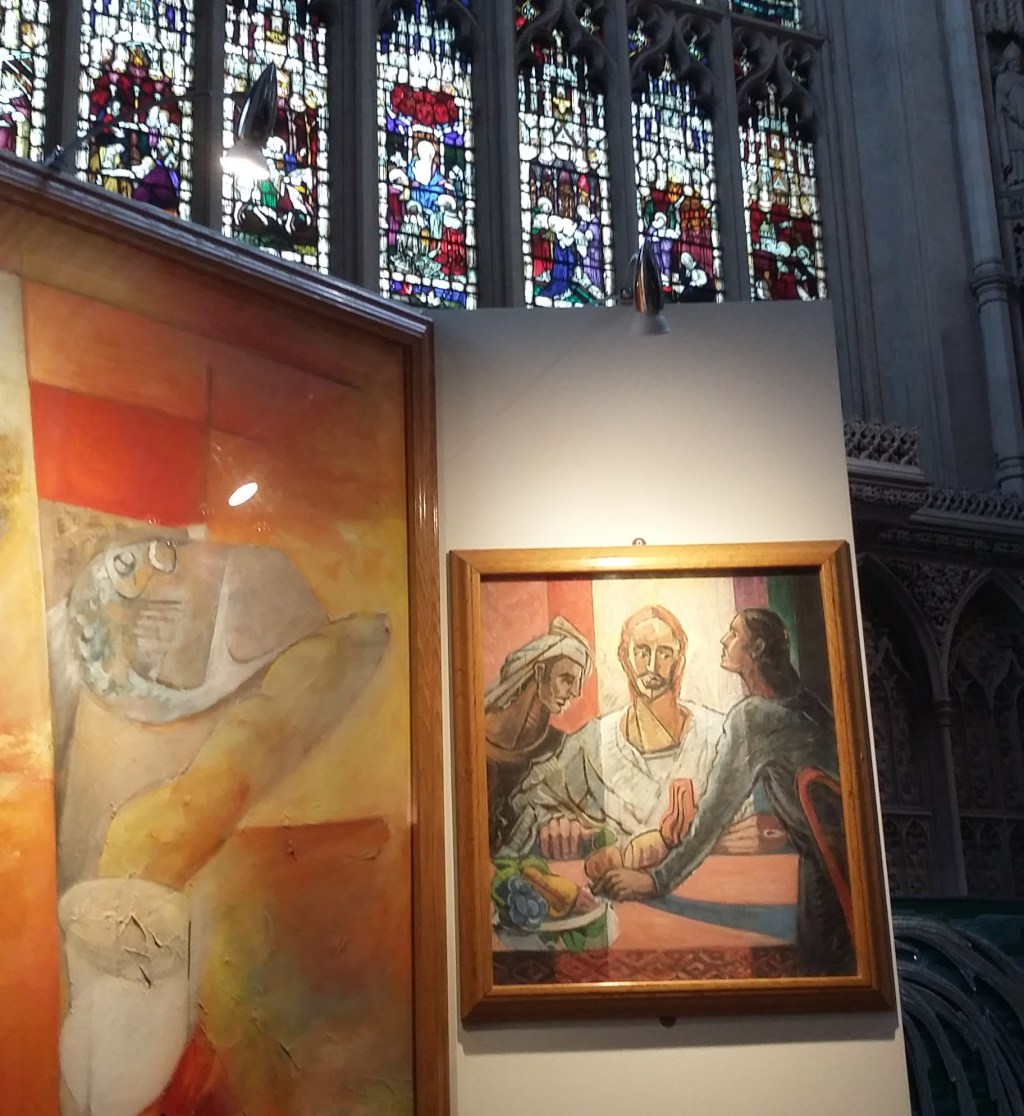
Bath Abbey stands at the heart of the city of Bath, dominating the city’s skyline, and is the epicentre of the city’s cultural and spiritual life. A place of Christian worship for hundreds of years and visited by millions of tourists every year, the Abbey’s walls, windows and flagstones echo with the comforting continuity of history and a people’s cultural heritage.
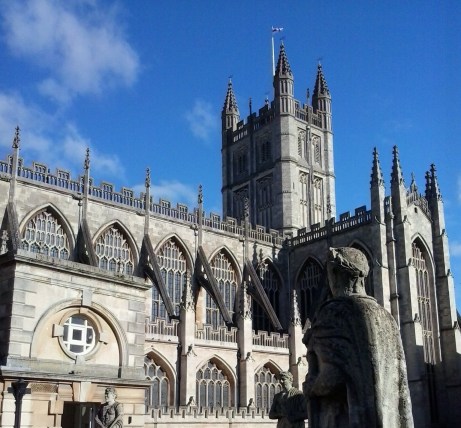
Two years ago, in October 2016, Bath Abbey welcomed a temporary exhibition of religious artwork comprised of paintings from the Methodist Collection of Modern Christian Art. Formed in the 1960s by Dr John Morel Gibbs and Rev. Douglas Wollen, the Methodist Collection has often been used in arts festivals or educational projects (Wollen, 2010). Originally touring in the 1960s under the name ‘The Church and the Artist’ to 30 venues around the country with more than 100 000 people attending at each of the venues, the collection was to be housed indefinitely at Kingswood School in Bath (Wollen, 2010). However, through the latter 20th Century the collection has been housed elsewhere, including at Westminster College in Oxford, now part of Oxford Brookes University (Wollen, 2010). Today the collection is shown in chapels, churches and cathedrals, museums and galleries, schools, colleges and universities across the country (Kent, 2010). The Reverend Graham Kent explains the importance of the collection;
“The Collection drives us to think about what Christ means to us and to look again at the Bible story: this has been the role of the visual arts as part of the language of the Church for most of its history.” (Kent, 2010)
The exhibition, entitled Fully Alive, explored what it means to be ‘Fully Alive’ by considering the life and teachings of Jesus Christ through the use of themes such as sacrifice, death, resurrection, love and compassion (Bath Abbey, 2011). These themes were interpreted through the eyes of 20th Century artists who explore their subject from a modern perspective.
The exhibition was well laid out in the North Aisle, on the left as you walk in the door of the Abbey. Plain boards provided hanging space and allow each painting to ‘breath’. However, the boards were somewhat stark and perhaps sat unnaturally with the Abbey’s breath-takingly beautiful gothic surroundings; this of course may have been the point. The exhibition was divided into themed sections with boards describing each section. There was a strong continuity of the overall theme, though the numbering system appeared at odds with the themed sections and felt at times somewhat redundant. Interpretative and explanatory text accompanied each painting in copious amounts. Indeed, such heavy text tends to draw the viewer away from the paintings themselves until one disregarded the text altogether in order to fully contemplate the artwork without hindrance.
Whilst the physical production of the exhibition perhaps could have been stronger, this cannot be said for the artwork on display which could not fail but leave a deep impression on the viewer.
The pool of Bethesda, painted by Edward Burra, depicts a harrowing scene of grotesque human bodies suffering from deformities, injuries and illness. These sick men litter the background of the image, clustered around the pool and collecting in the dark cavernous spaces created by the grey stone porticos. In the foreground is the image of Jesus healing a sick man. In the biblical story Jesus vanishes into the crowd before anyone can give him credit for this miracle. When understood in its biblical context, the painting challenges us to consider our attitude to charity and kindness in a world of deep human suffering.
An overriding theme of the exhibition was its focus on sacrifice, brutally depicted by numerous portrayals of the crucifixion of Christ. One particular example is a painting entitled Crucified tree form – the agony by Theyre Lee-Elliot. Jesus is depicted in an excruciating pose, morphed into a tree-like form and draped with strands of barbed wire. It is a very painful image and one that asks us to contemplate how the brave sacrifice of the men who die in the senseless blood-shed of war is mirrored in that of Christ’s crucifixion.
This rather dark contemplation was contrasted by another painting in the exhibition which gives a different perception of sacrifice. The Washing of the Feet is a much more intimate scene between two figures; Jesus, bent on one knee whilst washing the feet of Simon Peter. Painted by Ghislaine Howard, this image gives a sense that sacrificing one’s dignity should never impede one’s ability to serve others. Both these paintings are reminiscent of the crucial interpretation of Jesus’ teaching which underpins the Christian Faith; that we should love and serve others before ourselves.
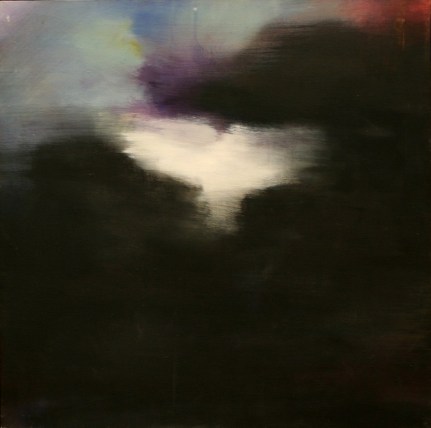
Towards the end of the exhibition it was possible to stumble upon a shy but very powerful work of art. The haunting image of a bird-like form hovering in the darkness; a faint beacon of light emanating from this symbolic juxtaposition of movement and stillness. The painting known as Pentecost could be found tucked away in a small side chapel towards the East end of the Abbey. Painted in 2003 by John Brokenshire, the image depicts a white form, resembling perhaps a dove, hovering in the darkness. Whilst the dove is a universally recognised Christian symbol of peace, this painting also reflects Christ’s guiding light in an otherwise bleak world filled with darkness and inhabited by mankind.
These paintings, among others, are what made the exhibition worth seeing. They not only interpret multiple themes central to the Christian Faith, but also challenge us to find relevance and meaning in the context of our everyday lives. Fully Alive drew on ancient religious and cultural traditions to explore the modern world’s understanding of its past identity and how it can shape the way we think today. The Methodist Collection is not only an important collection of the Church’s artwork, which has been a continuous presence in Christianity for centuries, but is also a poignant reminder of the values and beliefs that are a crucial part of the western world’s cultural past and present.
Although the Fully Alive exhibition at Bath Abbey has long since closed, paintings from the Methodist Collection continue to tour the country in a variety of themed exhibitions. A different selection of artwork from the collection is currently on show until 30th September 2018 in Winsford, Cheshire, in an exhibition entitled Salt and Light. The next exhibition to display artwork from the collection will be at the Royal Hibernian Academy in Dublin from 14th November to 21st December 2018.
 Stephen J. Dunning
Leave a comment