It has now been a week since the symbolic events of 7th June when Black Lives Matter protesters pulled down the statue of Edward Colston from its pedestal in Bristol’s city centre and dropped it in the harbour to lie in a watery grave. Colston’s statue has since been retrieved and plans are being made for it be placed in one of the city’s museums. However, these events have reinvigorated campaigns across the country.
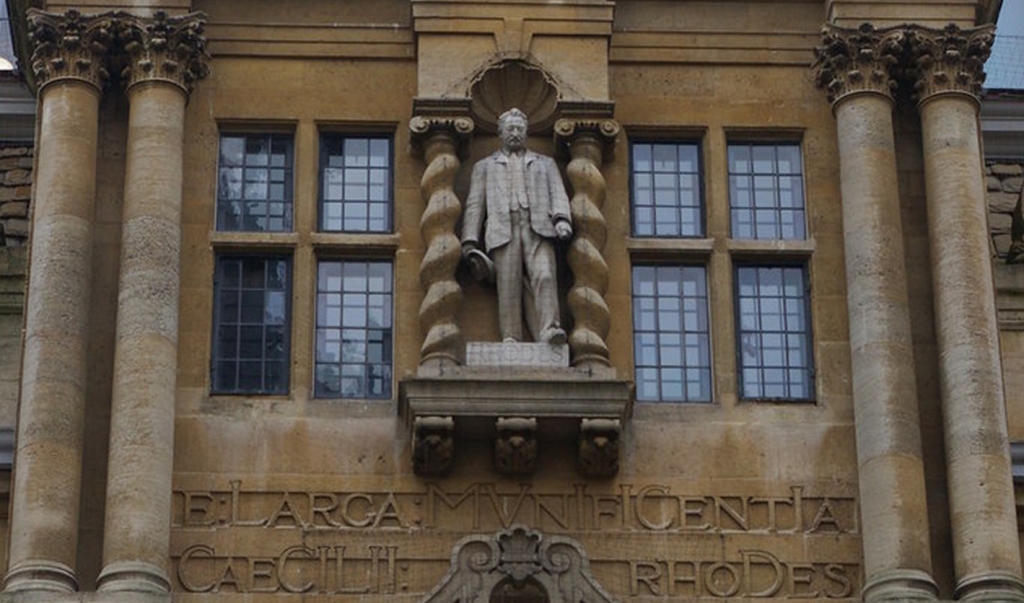
In Oxford, the Rhodes Must Fall campaign has renewed its protests to have the statue of Cecil Rhodes removed from the exterior of Oriel College, although the College has so far not budged on its stance that leaving it up allows the history to be on view and talked about. This is an argument that has often been used in defence of leaving statues such as Rhodes and Colston standing. However, while it is important that these figures and their roles in historical events continue to be remembered and discussed, this argument is weak and ignores the crucial point made in my previous article, Why statues have no place in modern society, that a statue depicting a person’s likeness and placed on a pedestal without full historical context does more harm than good as it pervades political power and ideological bias.
Rhodes studied at Oriel College in the 1870s, before building a career as a businessman and politician in southern Africa. He demonstrated very strong imperialist politics and often expressed the view that the British people were superior to other nationalities and cultures. On his death in 1902, he left money to Oriel College for the Rhodes Scholarship programme, which has been awarded to more than 8,000 overseas students. However, he has also been quoted from his Will as suggesting that the Anglo-Saxon race was “the first race in the world”. It could be argued that his views were not dis-similar from that of 20th century Fascist and Nazi organisations who advocated the superiority of the ‘Aryan race’, an ideology that left the streets of Europe stained in blood and turmoil after the events of the Second World War and the Holocaust. During his lifetime, he ardently advocated for aggressive colonisation of as many countries as possible by the British. He personally had a major influence on the development of southern Africa, including the foundation in 1895 by his British South Africa Company of the territory of Rhodesia. Today, the former territory of Rhodesia is now the two independent countries of Zimbabwe and Zambia after many years of civil strife.
Rhodes is an important figure from 19th century history, yet much of what he represents is steeped in colonialism and racist, or at the very least highly imperialist, views. His statue was erected as a deliberate choice by Oriel College to honour one of their former students and show appreciation for his philanthropy towards them at the end of his life. It teaches the students of today, who crane their necks skyward, to revere and admire a man whose views were eerily close to those of 20th century Nazism. The decision to leave the statue standing in its current location, without proper and balanced historical contextualisation made evident on the wall beneath, is a political statement by Oriel College that they are wholly unsympathetic to the oppressive racial bias felt by those standing below. There has been much debate in recent days as to whether Nelson Mandela would be in favour of the statue’s removal. Indeed, Mandela’s remarks from a speech in 2003 have been used by some to suggest he would oppose the statue’s removal. However, Mandela was a man with his own complex history and is well known for a change in his views over time. We cannot claim to know what he might think or say on such a subject, particularly after his death. His views, therefore, are somewhat irrelevant. What matters are the views and feelings of those standing below the statue today.
The points raised in these articles are also applicable to many other statues across the country. In particular, the statues of Winston Churchill and Horatio Nelson in London’s Parliament and Trafalgar Squares come to mind. While these were major political figures, their statues are there to commemorate only one side of their part in history. Churchill was a powerful and very competent political statesman who led the country through the Second World War. This rightly places him as an historical figure who should be remembered. But we should also remember his views, words and actions, on other areas of politics. In particular, he was strongly imperialist and held deeply racially prejudiced views of colonial populations. It should be noted that part of the reason why people ignored his early warnings of the dangers of Hitler is that he used the same language when describing the danger that Gandhi posed to Britain and her empire. Is it right, therefore that his statue remains on public display, encouraging people to revere and idolise him without the full context of his role in history, both positive and negative? Likewise, Nelson stands atop his incredibly tall column, a very powerful statement of imperial ideology. He is remembered for his role in the Napoleonic Wars and for winning the Battle of Trafalgar while being wounded in the process. It is right that he should be remembered for these very heroic acts. Yet, he was also a political opponent of the abolition of slavery and took a very strong right-wing political stance based on prejudiced views. Should we not remember this as well?
Statues are inherently flawed as a form of public memorial as they focus our attention on idolatry and a one-sided view of history. Most of these statues were erected in previous, less enlightened times. They are outdated methods of public commemoration and are almost invariably erected as a form of political statement. Despite this, we still put up statues of people today. Are we not perpetuating the same flawed ideology?
The visual legacy of slavery, British imperialism and other parts of our history is evident all around us through the buildings and landscapes we continue to inhabit. It is a complex issue and there is no easy answer. Yet, the difference between statues and other parts of the built landscape is that a statue serves no other purpose than to make an expression or imposition of political power or ideology. The rest of our built landscape is much more multifaceted and not so easily dispensed with. Ultimately, whether we leave statues and buildings in place matters less than whether or not we address the issue of an imbalance in the recognition of historical events linked to them. If we choose to balance the historical narrative, we remove the potency of the previously biased political messaging.
So, what should we do with statues if we remove them? Although the dropping of Colston’s statue into the harbour was symbolic, we should avoid making statues the lightning rod for open conflict on the streets. This can easily be avoided if the statues are removed peacefully by authorities, such as in the case of the removal of the statue of Robert Milligan from outside the Museum of London Docklands. The act of removal, if done appropriately, is not a ‘capitulation’ as some would suggest but rather a recognition of the outdated and oppressive nature of the statue in question. Its removal represents a progressive and appropriate response to the multicultural society we live in today. Placing these statues in museums where they can be given a much more balanced and educative contextualisation allows us to remove their power as symbols of political or racial oppression, whilst keeping them alive as part of a more balanced historical narrative. That said, we must remember that even museums often display inherent biases. What objects are selected for display and how they are interpreted is inherently political. We must therefore be aware of this and attempt to counteract the natural biases even in these settings.
However, re-contextualising our controversial statues should not be the end of the story. It is merely the first in a series of actions we can take to address the prejudices and inequality that remain in our society. Making British Imperialism, its positives and negatives, and a basic history of other countries and continents a compulsory part of our school curriculum would help to broaden our children’s minds and allow them to see Britain and our place in the world from a much more balanced viewpoint. Taking steps to address the inequality and racial biases in other parts of our society would allow us to become a truly modern and enlightened nation that treats all of its citizens with respect. These tasks are not easy and represent major change in our society. However, we should not be afraid of change. It is what makes history.
Photograph of Statue of Cecil Rhodes, High Street frontage of Oriel College, Oxford
cc-by-sa/2.0 – © Christopher Hilton – geograph.org.uk/p/5481003
 Stephen J. Dunning
Leave a comment